
GLP-1 and Strength Training: 5 Reasons to Lift Weights
Your appetite is quieter. Your clothes fit differently. The scale is finally moving.
Then your trainer asks, “How’s your strength training going?”
Before you pretend your connection dropped, hear us out.
If you’re taking a GLP-1 medication, strength training deserves a spot in your routine. Not because you need to become a bodybuilder. Not because medication is “cheating.” And definitely not because every workout should leave you negotiating with the stairs.
The goal is to lose fat while protecting the muscle, strength, and confidence that help you feel good in your body.
Medications such as semaglutide and tirzepatide can be valuable tools for treating obesity and related health conditions. But a smaller appetite doesn’t automatically create a complete nutrition and exercise plan.
That’s where resistance training comes in.
Let’s break down five reasons to strength train while taking a GLP-1, what a realistic routine looks like, and how to support your results without turning fitness into another full-time job.
This article provides general education, not individualized medical advice. Your prescribing clinician manages your medication; a qualified trainer and registered dietitian can help you build the exercise and nutrition pieces.
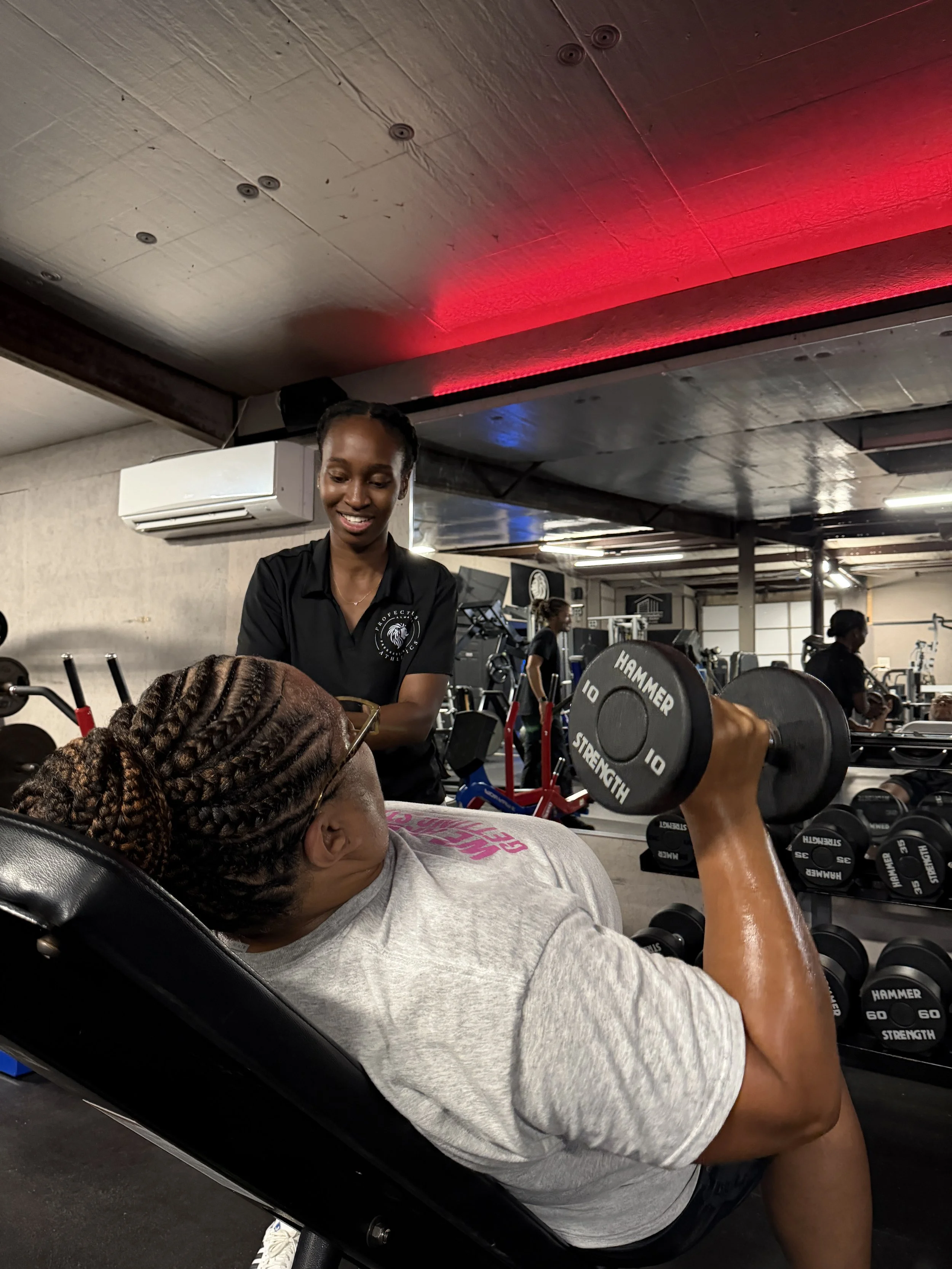
Personal Trainer Amara guiding a client through an Incline Dumbbell Press
First, What Do GLP-1 Medications Actually Do?
GLP-1 medications act on pathways involved in appetite, fullness, and blood sugar regulation. Depending on the medication and individual response, people may feel satisfied sooner and think about food less frequently.
You’ve probably heard names such as Wegovy, Ozempic, Zepbound, and Mounjaro.
Wegovy and Ozempic contain semaglutide. Zepbound and Mounjaro contain tirzepatide, which acts on both GIP and GLP-1 receptors. These brands have different approved uses; they aren’t interchangeable prescriptions.
For simplicity, we’ll use “GLP-1” as shorthand here.
Common side effects can include nausea, constipation, diarrhea, vomiting, and abdominal discomfort. Those symptoms, combined with reduced appetite, can make eating and drinking enough more challenging.
Strength training doesn’t cancel these side effects. Its job is different: helping you maintain physical capacity and supporting healthier body composition as your weight changes.
Medication and exercise aren’t competing strategies. They have different jobs on the same team.
1. Strength Training Helps Preserve Muscle During Weight Loss
Here’s the part the bathroom scale leaves out: weight loss isn’t automatically fat loss.
When body weight decreases, the change can include fat, water, and lean tissue. Skeletal muscle is part of lean tissue, but “lean mass” and “muscle” aren’t identical terms.
That distinction matters when you see dramatic headlines about GLP-1 muscle loss.
Losing some lean tissue can occur during weight loss with or without medication. It doesn’t mean everyone taking a GLP-1 will become weak or develop a muscle-wasting condition.
Still, muscle deserves attention, especially when appetite drops substantially.
Think of resistance training as a regular message to your body:
“We’re still using this muscle. Please keep it on the payroll.”
Lifting weights, using resistance machines, and performing appropriately challenging bodyweight exercises provide a stimulus that helps support muscle retention.
A joint advisory from four major medical and nutrition organizations emphasizes resistance training and adequate nutrition during GLP-1 treatment. It also notes that increasing protein alone is unlikely to adequately preserve muscle without structured resistance training.
Translation: the protein shake and the workout have different assignments.
Neither guarantees that you’ll preserve every ounce of muscle. Your age, health, nutrition, training history, and amount of weight lost all matter.
But a thoughtful strength-training plan gives muscle a reason to stay.
2. It Supports the Body Composition Changes You Actually Want
Most people don’t walk into a gym dreaming about a particular bathroom-scale display.
They want their clothes to fit comfortably. They want to feel more confident in photos. They want to recognize themselves again.
That’s a body composition conversation, not just a weight conversation.
Body composition describes what makes up your body, including fat and lean tissue. Two people at the same weight can look and function differently because their body composition differs.
Strength training can help maintain or develop the muscle underneath the fat you’re losing. Depending on your starting point, that can contribute to a more defined appearance as body fat decreases.
No, lifting weights won’t automatically make you bulky.
And no, doing 400 arm exercises won’t selectively remove arm fat. If spot reduction worked, chewing gum would have given us all sculpted jawlines by now.
It’s also important to keep expectations realistic. Strength training doesn’t guarantee tighter skin or prevent loose skin after substantial weight loss. Skin changes depend on several factors, and exercise cannot control all of them.
What strength training can do is help you pursue fat loss without treating muscle as disposable.
That’s a better plan than chasing the smallest possible number and hoping everything else sorts itself out.
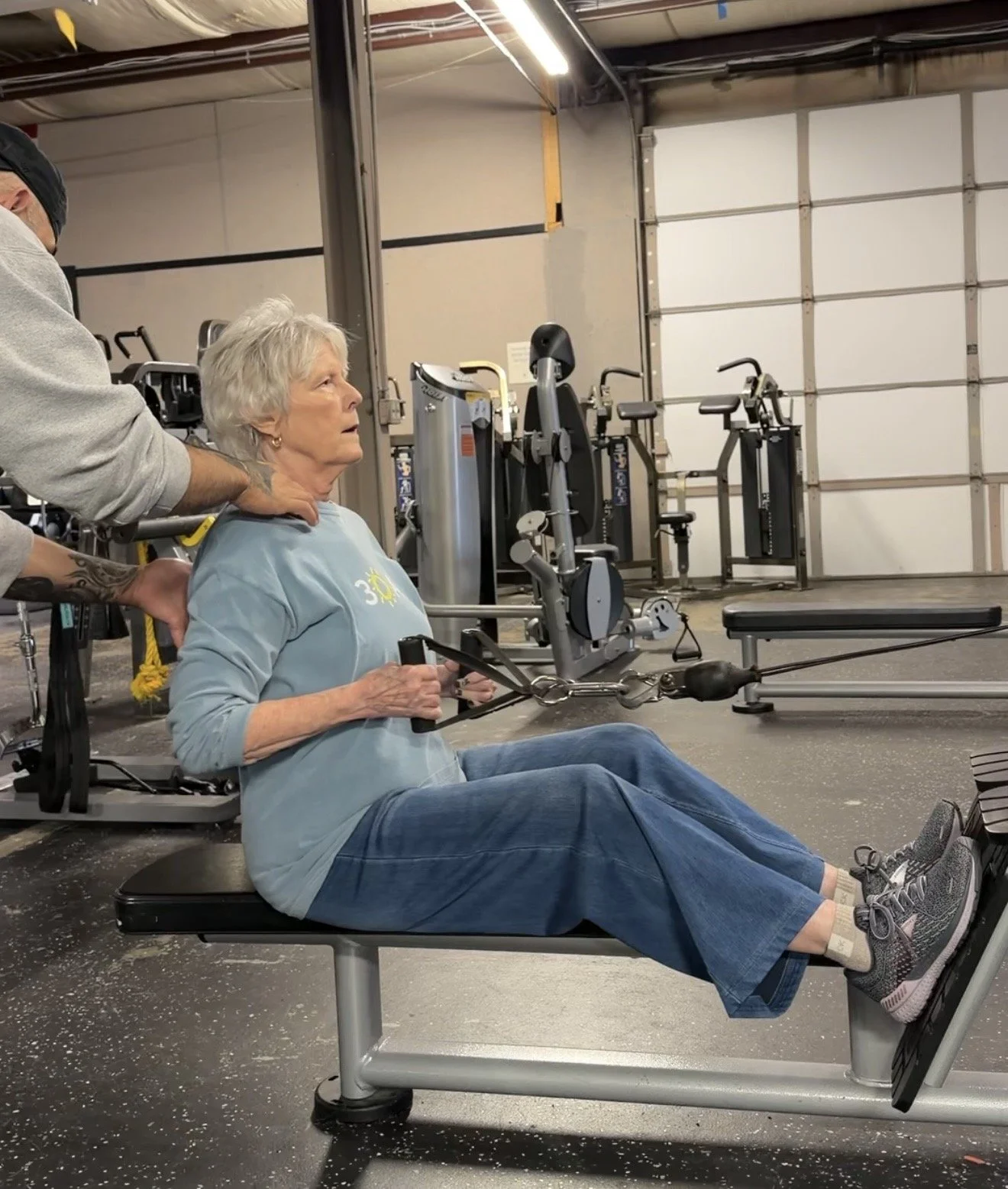
Owner Ben showing Claudette, 79, proper form on a cable row
3. It Helps Keep Everyday Life Feeling Easier
Muscle isn’t just for gym mirrors.
It helps you stand up from a chair, climb stairs, carry groceries, move luggage, and get down to the floor and back up.
Those things might not make a dramatic transformation video. They matter anyway.
During significant weight loss, maintaining strength and physical function deserves attention alongside changes in clothing size.
Resistance training builds practice with basic movement patterns: squatting, hinging, pushing, pulling, carrying, and stabilizing.
You’re not learning a squat because your trainer has a personal vendetta against chairs.
You’re practicing a movement you use every day.
For adults in midlife and beyond, preserving strength becomes particularly valuable. Aging can affect muscle and physical capacity, making consistent training an investment in future independence.
That doesn’t mean every workout needs to be harder than the last.
Some weeks, maintaining your usual weights with good technique is a meaningful win, especially while losing weight or adjusting to medication.
Progress can look like carrying the same groceries with less effort, not just carrying a smaller body.
If strength keeps declining, however, don’t automatically label it “part of the process.” Persistent weakness deserves a closer look at nutrition, recovery, training demands, and medical factors.
4. It Gives Your Bones a Reason to Stay Resilient
Muscle usually gets the spotlight. Bones deserve a speaking role.
Bones respond to the forces placed on them. Appropriately selected resistance exercises provide loading that can support bone health over time.
That matters during weight loss, when changes in body weight, nutrition, and activity can affect bone.
It also matters for women approaching or experiencing menopause, when bone health becomes an especially important conversation.
The GLP-1 nutrition advisory highlights preserving both muscle and bone. It cites a trial in which exercise combined with liraglutide preserved bone mineral density, while medication alone reduced it.
That finding supports including exercise. It doesn’t prove that every lifting program prevents bone loss with every GLP-1 medication.
Details matter: the exercise, your health history, nutrition, and consistency all influence the plan.
If you have osteoporosis, previous fractures, significant pain, or balance concerns, get individualized guidance. Some movements and loading strategies need modification.
Your trainer’s job isn’t to hand you the heaviest dumbbell available and announce, “For your skeleton!”
It’s to choose exercises you can perform safely, then progress them appropriately.
Bone health is another reason to train for what your body can do, not only what it weighs.
5. It Builds Habits That Support Long-Term Health and Results
Reaching a target weight isn’t the end of taking care of yourself.
You still need a routine that supports your health when the early excitement wears off, your schedule gets messy, or your weight stops changing as quickly.
Strength training provides a repeatable habit with benefits beyond calorie burning.
Resistance exercise can improve insulin sensitivity, helping your body respond to insulin more effectively. It also supports physical capacity and gives you performance goals that don’t depend on a smaller scale number. Maybe you add a few repetitions. Maybe your balance improves. Maybe the exercise that felt intimidating becomes familiar.
Those wins matter.
Let’s also retire one exaggerated claim: adding muscle does not turn your metabolism into a furnace that makes weight regain impossible.
Muscle contributes to energy use, but its resting calorie requirements are often oversold.
Likewise, strength training doesn’t guarantee that you can stop medication without regaining weight. Obesity can require long-term treatment, and medication decisions belong with your prescriber.
The National Institute of Diabetes and Digestive and Kidney Diseases emphasizes that weight-management medications work best alongside lifestyle changes.
The value of strength training isn’t a promise that you’ll never regain weight. It’s a foundation you can keep using as your needs change.
How Often Should You Strength Train While Taking a GLP-1?
For many beginners, two full-body sessions per week is a practical starting point. Three can work well when your schedule, nutrition, and recovery support it.
You don’t need to jump straight into four demanding workouts because you’re motivated on Monday.
Monday has made promises before.
General physical activity guidance recommends muscle-strengthening activity at least twice weekly. GLP-1-focused recommendations also emphasize regular resistance exercise, with the exact plan adapted to the individual.
Here’s a sensible starting framework:
| Training variable | Practical starting point |
|---|---|
| Frequency | 2 to 3 nonconsecutive days weekly |
| Session length | Approximately 30 to 60 minutes |
| Exercises | 4 to 6 movements covering major muscle groups |
| Working sets | Start with 1 to 2; build toward 2 to 3 as appropriate |
| Repetitions | Often 8 to 12 with controlled technique |
| Effort | Challenging, with about 2 to 3 good repetitions left |
| Rest | Usually 1 to 3 minutes between sets |
| Progression | Gradually add repetitions or resistance |
These are general examples, not individualized exercise prescriptions. Your starting point may be lower if you are deconditioned, recovering from illness, or managing medical limitations. Talk with your clinician before starting if you have health concerns.
You don’t need to train to failure every set. Consistent, well-executed work beats turning every session into a survival documentary.
Sample Beginner Full-Body Workout
After a brief warm-up and lighter practice sets, a session might look like this:
| Exercise | Working sets | Repetitions |
|---|---|---|
| Sit-to-stand or leg press | 2 | 8 to 12 |
| Machine chest press | 2 | 8 to 12 |
| Seated cable row | 2 | 8 to 12 |
| Glute bridge or coached hip hinge | 2 | 8 to 12 |
| Supported step-up | 1 to 2 | 6 to 10 per side |
Begin with a brief warm-up and lighter practice sets. Choose exercises appropriate for your ability and medical limitations. Start with two nonconsecutive sessions weekly, rest about 1 to 3 minutes between sets, and finish each set with approximately 2 to 3 good repetitions left. This is a general example, not an individualized exercise prescription.
Choose variations that match your ability, comfort, and equipment.
Repeat twice weekly initially, allowing recovery between sessions. If you recover well, a third session or additional sets may be appropriate.
Progress one thing at a time. More weight, more repetitions, and more sets don’t all need to arrive together.
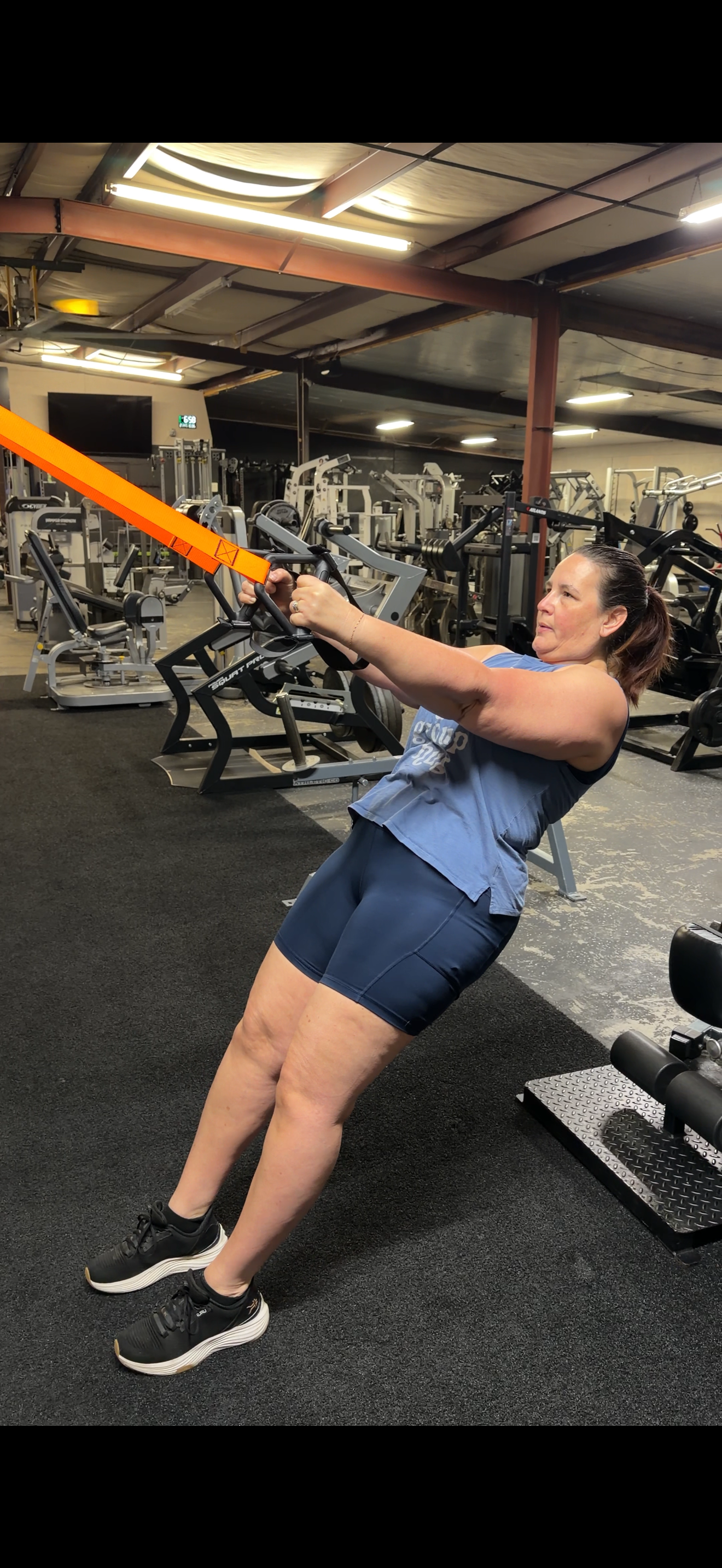
Personal Training Client Amanda performing a TRX Row
Protein Matters More When Your Appetite Is Smaller
A reduced appetite can make eating less feel easier.
It can also make eating enough protein surprisingly difficult.
When meals get smaller, you have fewer opportunities to meet your nutritional needs. That’s why protein intake deserves deliberate attention during GLP-1 weight loss.
For many adults losing weight and strength training, roughly 1.2–1.6 grams of protein per kilogram daily can be a useful discussion range. It isn’t a universal prescription.
Here’s how that calculation looks using current body weight:
| Body weight | Illustrative daily protein range |
|---|---|
| 150 pounds | 82 to 109 grams |
| 180 pounds | 98 to 131 grams |
| 200 pounds | 109 to 145 grams |
| 220 pounds | 120 to 160 grams |
| 250 pounds | 136 to 181 grams |
These examples use approximately 1.2 to 1.6 grams of protein per kilogram of current body weight daily. They are not individualized prescriptions. For people with significant obesity, a registered dietitian may use an adjusted or target weight instead. Kidney disease and other medical conditions can change protein needs; consult your clinician or registered dietitian for an appropriate target.
Rather than cramming everything into dinner, spread protein across meals and snacks. Eggs, Greek yogurt, fish, poultry, tofu, beans, cottage cheese, and tolerated protein drinks can all contribute.
Smaller portions may be easier when fullness arrives quickly.
And remember: protein isn’t the entire nutrition plan. You still need adequate overall food, fluids, fiber, fats, carbohydrates, and micronutrients.
Living on coffee and one protein shake isn’t a muscle-preservation strategy. It’s a reason to ask for support.
What About Cardio, Walking, and GLP-1 Side Effects?
Keep the walking. Keep the heart-health benefits. Just don’t ask cardio to do every job.
Aerobic exercise supports cardiovascular fitness. Strength training provides a more direct muscle-loading stimulus. They complement each other.
A general goal is to gradually work toward at least 150 minutes of moderate-intensity aerobic activity weekly, as appropriate for your health and ability. Starting with a short walk is fine.
Your plan should also respect how you feel.
Mild symptoms may call for a shorter session or a different exercise. Persistent symptoms call for medical guidance, not a motivational speech.
If you have persistent vomiting, dehydration, severe or persistent abdominal pain, or cannot maintain food and fluid intake, seek prompt medical advice rather than training through it.
If you also use insulin or a sulfonylurea, ask your clinician about exercise and low-blood-sugar precautions.
There’s no universal rule that everyone should train a specific number of days after an injection. Track your response and coordinate with your care team.
Our Recommendation: Make Muscle Part of the Plan
At Profectus Athletics, our recommendation is straightforward:
Use the medication as prescribed, protect your nutrition, and give your muscles consistent work to do.
Start with two manageable full-body strength sessions each week. Build toward three if your recovery and schedule allow. Choose movements you can perform confidently, and progress gradually.
Establish an individualized protein target rather than copying someone else’s meal plan. Keep walking, prioritize sleep, and tell your prescriber when side effects interfere with eating, drinking, or daily function.
Then measure more than weight.
| What to track | What it can tell you |
|---|---|
| Weight trend | How overall body weight changes over time |
| Exercise records | Whether strength performance is holding steady or improving |
| Daily function | Whether stairs, groceries, and other tasks feel easier |
| Measurements or optional photos | Additional context for physical changes |
| Appetite, symptoms, and recovery | Whether the plan needs adjustment |
Measurements and photos do not directly measure muscle mass. Even body-composition testing has limitations. Use several indicators rather than treating one number as the final verdict, and discuss persistent weakness or symptoms affecting food and fluid intake with your prescribing clinician.
Measurements and photos don’t directly measure muscle. Even body-composition testing has limitations. Use several indicators rather than treating one number as the final verdict.
Most importantly, don’t chase faster weight loss at the expense of feeling capable.
You deserve a plan that supports your health, confidence, and everyday life, not just a lower weigh-in.
If you’re taking a GLP-1 and aren’t sure where to start, ask Profectus Athletics about a free first session. We can help you find an appropriate training starting point, while your medical team manages your treatment.
Let the scale report your weight. Don’t let it write your entire success story.
Sources & Further Reading
This article draws on published clinical guidance and research. The practical training examples are general recommendations from Profectus Athletics, not individualized medical prescriptions.
Mozaffarian D, et al. (2025). “Nutritional priorities to support GLP-1 therapy for obesity.” Joint advisory from the American College of Lifestyle Medicine, American Society for Nutrition, Obesity Medicine Association, and The Obesity Society. Obesity. Read the advisory.
National Institute of Diabetes and Digestive and Kidney Diseases. “Prescription Medications to Treat Overweight & Obesity.” Read the guidance.
Mehrtash F, Dushay J, Manson JE. (2025). “I Am Taking a GLP-1 Weight-Loss Medication.” JAMA Internal Medicine. Read the patient guidance.
Want to learn more? Call us at 501-864-4183 or schedule your First Session Free with Profectus Athletics in Sherwood, AR.
Instagram: @profectusathletics
Facebook: www.facebook.com/profectusathletics